Data quality and strategy are becoming the foundation of effective PPC advertising
For nearly three decades, keywords were the main driving force behind paid search. PPC specialists spent weeks researching keywords, divided accounts into hundreds of small ad groups, and manually adjusted every bid. However, with the development of automation and artificial intelligence, the role of keywords has shifted: from the primary optimization tool, they have become just one of many signals used by algorithms.
Today, the effectiveness of advertising campaigns depends less and less on manual configuration and increasingly on a well-developed strategy and the signals provided to advertising platforms. The key priorities now include conversion data accuracy, deep integration of first-party customer data, the relevance of advertising creatives, landing page usability, and overall strategic campaign management.
From Keywords to Signals: How the Role of Keywords in Google Ads Is Changing
To understand the current transformation, it is worth revisiting the traditional PPC approach. Previously, campaign setup required extensive micromanagement: specialists had to build exhaustive negative keyword lists, create complex ad group structures for different match types, and constantly adjust cost-per-click bids.
Today, the situation is different: advertising platforms have taken over most routine tactical tasks. So how is the role of keywords in Google Ads changing in this new environment? Modern marketers no longer treat keywords as strict instructions for displaying ads, but rather as one of many signals used by auction-time algorithms. The system independently decides whether to show an ad based on a combination of behavioral signals and the probability of a conversion.
Algorithms in Action: How AI Is Changing PPC Advertising and Audience Reach
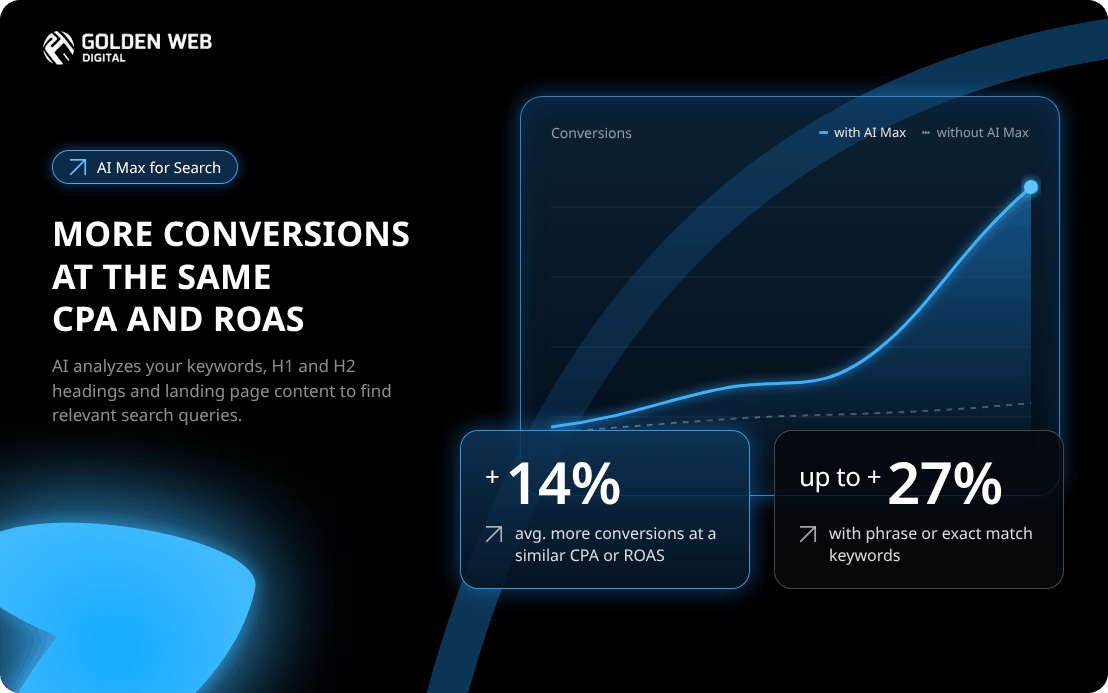
Next-generation automation tools do much more than identify synonyms — they analyze context and actual user intent in depth. To understand how AI is transforming PPC advertising in practice, it is worth looking at AI Max for Search.
This tool uses your Google Ads keywords, headings (H1, H2), and overall landing page content to automatically identify relevant search queries. According to Google, using AI Max can generate an average of 14% more conversions at a similar CPA or ROAS. For campaigns that primarily use phrase or exact match keywords in Google Ads, this increase can reach 27%.
Meanwhile, Performance Max and Demand Gen help expand reach across all stages of the sales funnel:
- Performance Max uses all Google channels (Search, Shopping, YouTube, Display, Maps, Discover) to identify audiences most likely to convert across each of them.
- Demand Gen focuses on the upper stages of the funnel, generating initial interest and building visual brand awareness.
Thus, artificial intelligence goes far beyond traditional search, automatically combining different channels and formats to maximize customer acquisition.
The New Control Center: Strategic Advertising Campaign Optimization
When algorithms independently select search queries and manage bids, a key question arises: what actually determines advertising success? Today, advertising campaign optimization is no longer about manipulating cost-per-click bids, but about the quality of the data we provide to artificial intelligence.
If the system is given a primary goal of generating cheap but secondary actions — such as newsletter subscriptions — it will quickly produce a stream of low-value leads. However, when you provide algorithms with a clear value framework and specify which orders generate the highest profits, the system begins to focus on attracting customers and leads with greater business value.
Building a Foundation for Algorithms: Effective Advertising Campaign Management Through Data and CRM
Modern advertising campaign management requires a reliable system for collecting, transmitting, and utilizing data. Smart Bidding algorithms depend entirely on the events and conversion values you provide to the system.
To maximize the effectiveness of paid advertising channels, it is essential to:
- Implement server-side conversion tracking to improve the completeness and accuracy of data transmitted to advertising platforms.
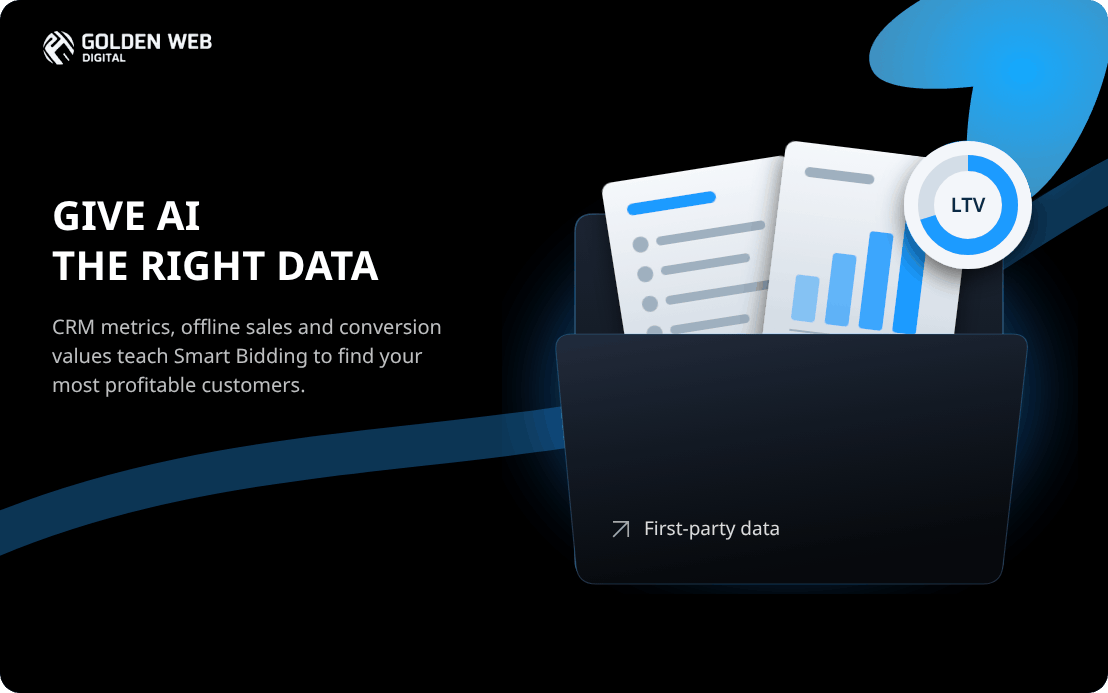
- Provide first-party data — customer lists, CRM metrics, purchase history, and customer lifetime value (LTV).
- Differentiate conversion values by teaching the system to prioritize high-value purchases or repeat orders over initial or secondary actions.
- Import offline conversions so that algorithms can identify which leads actually resulted in sales or signed contracts.
Consistent use of first-party data transforms advertising platforms from unpredictable tools into manageable systems for acquiring the most valuable customers.
Creatives and UI/UX: Modern Google Ads Advertising
The traditional perception of Google Search Ads as nothing more than a few headlines and three lines of description is a thing of the past. Today, advertising creatives — banners, videos, and text — effectively serve as an additional targeting tool. Artificial intelligence analyzes visual and textual elements to independently determine which audiences will find them most interesting and relevant.
Furthermore, the quality of the landing page itself plays a critically important role:
- AI Max and Performance Max analyze website content, using structured text, headings (H1, H2), and descriptions to generate automated ad variations and select the most relevant destination URLs.
- Poor user experience (UX), slow loading speeds, or weak content structure limit campaign performance and reduce the likelihood of conversions.
Therefore, without a high-quality landing page and well-designed creatives, even the most advanced artificial intelligence cannot deliver the desired results.
From Operator to Strategist: How Google Ads Is Changing the Role of PPC Specialists
The transformation of advertising tools is fundamentally changing the requirements for PPC specialists. Modern Google Ads campaigns no longer require someone who spends hours manually adjusting bids or reviewing hundreds of search queries every day.
The specialist's primary responsibility is now shifting from routine execution to the role of a strategic architect:
- Building and monitoring measurement systems: implementing reliable analytics and correctly defining the value of business events.
- Data auditing and preparation: ensuring the accuracy, cleanliness, and structured organization of first-party customer information.
- Developing creative frameworks: designing advertising concepts and testing hypotheses that provide meaningful signals to algorithms.
- Brand safety: establishing strict restrictions and monitoring frameworks to prevent automated advertising systems from displaying ads in undesirable or irrelevant contexts.
As a result, the PPC specialist evolves from a technical executor into a strategic business partner who manages algorithms rather than simply following them.
A New Skill Set: What Modern Google Ads Advertising Requires
The rapid evolution of marketing tools requires specialists to adapt quickly. Modern Google Ads advertising no longer relies on routine keyword selection — it demands a deep understanding of algorithm mechanics, AI model logic, and consumer behavioral psychology.
To confidently manage artificial intelligence rather than simply follow its automated recommendations, specialists should focus on three key areas of professional development:
- Deep understanding of marketing technology and data engineering: the ability to build end-to-end analytics, integrate CRM systems, configure server-side tracking, and transmit API events directly to advertising platforms.
- Expertise in UX/CRO and the customer journey (CJM): understanding how a landing page receives traffic, which visual and textual triggers address user concerns, and what transforms an ordinary click into an actual order.
- Critical monitoring and adjustment of AI: artificial intelligence lacks a complete understanding of business context and may generate incorrect hypotheses. The marketer's responsibility is to identify anomalies in key performance indicators, filter out irrelevant automated recommendations, and keep algorithms aligned with the company's business strategy.
Developing these skills makes marketers indispensable experts capable of transforming complex Google Ads algorithms into a predictable flow of conversions and a high return on investment (ROI).
Strategy as the Main Driver: Why Google Advertising Requires a New Approach
To summarize, keywords in PPC advertising have not disappeared entirely, but they have lost their status as the sole optimization lever. They have become one of many signals within a much larger data ecosystem.
Today, Google advertising requires businesses to adopt a systematic strategic approach. Companies that invest in first-party data, prioritize landing page quality, and establish clear frameworks for artificial intelligence gain a competitive advantage. Automation is highly effective at handling tactical tasks, but only people can determine the direction of development, the true value of customers, and the ultimate business objectives.
If you want to transform paid search into a predictable and highly profitable growth channel, professional PPC advertising services from Golden-Web Digital can help you achieve your goals. Our company develops and manages advertising campaigns with a strong focus on data quality, strategic business objectives, and the actual value of every acquired customer. By choosing Google Ads advertising services from the Golden-Web Digital team, you receive more than just launched campaigns — you gain a reliable technological foundation for scaling your business.