How a strong brand boosts SEO and makes organic website promotion more sustainable
Common practice: SEO website promotion and brand work are often planned as two separate areas that sometimes do not intersect at all within a single strategy.
The SEO team focuses on the technical state of the resource, semantics, and getting pages to the top of Google, while brand managers are fully immersed in social media, visuals, communication, and outreach.
But wait: does your potential customer divide the company into separate areas or tools? Of course not! A person perceives a business holistically and moves towards a purchase through a variety of touchpoints:
- first accidentally sees your viral Reels on Instagram;
- in a few days, enters a query into Google and comes across a useful article on the site;
- watches a practical case study or video review on YouTube;
- and then enters the name of your company directly into the search bar to place an order.
If you ignore even one of these channels, you are voluntarily giving away some of your customers (and profits!) to your competitors.
Competition on the Internet is unavoidable, but it can and should be won. This requires the right strategy for presence on all platforms at once:
Strong SEO ensures high search visibility and helps your business be found, while brand reinforcement ensures that you are chosen from hundreds of similar offers, remembered, and searched for again.
However, let's immediately dispel any illusions: a strong brand that is known, trusted, and talked about is not in itself an unconditional shield from Google search algorithm updates and does not automatically ensure that you are in the top positions for every keyword.
The synergy of these tools is not about magic, but about creating a scalable and sustainable ecosystem of business presence in the digital environment.
SEO and branding solve different problems — but lead to the same goal
At first glance, SEO and Brand Management may seem like they have nothing in common. They use completely different tools, work on different platforms, and even measure success with different metrics. However, their ultimate goal is the same: to bring in customers and increase revenue.
With the right synergy, these directions reinforce each other and create a win-win scenario where every engaged user moves towards a purchase. To build such interaction, it is important to clearly delineate the roles of each tool in the engagement chain.
- The task of SEO is to help a business be present where the user has already formulated a clear need or is looking for a solution to a specific problem.
For example, when a person searches for:
- "development of an online store";
- "Dentistry Ternopil";
- "buy Japanese collagen";
- "SEO website promotion".
At this stage, a potential client may not even know about the existence of your company. And it is high-quality SEO optimization of the site that allows you to appear at the right time in the top of Google and confidently enter the user's choice field.
- The task of Brand Management is to create awareness, build trust, and manage the perception of the company on social networks. At this stage, systemic branding for business is responsible for specific tasks:
- how the user will perceive the brand;
- Will he remember the name after the first contact?
- Will the brand be recognized during subsequent online meetings?
This is where it becomes clear how a brand affects SEO: it turns initial visibility in search into trust, and accidental clicks into a conscious choice for your company.
This interaction can be reduced to a simple and effective formula:
SEO creates visibility → brand builds recognition → repeat contacts increase the likelihood of choosing your company.
Systematic brand promotion on the Internet combines these steps into a single chain: from the first appearance in search results to the established brand demand and stable sales growth.
From non-branded to branded query: how user behavior changes
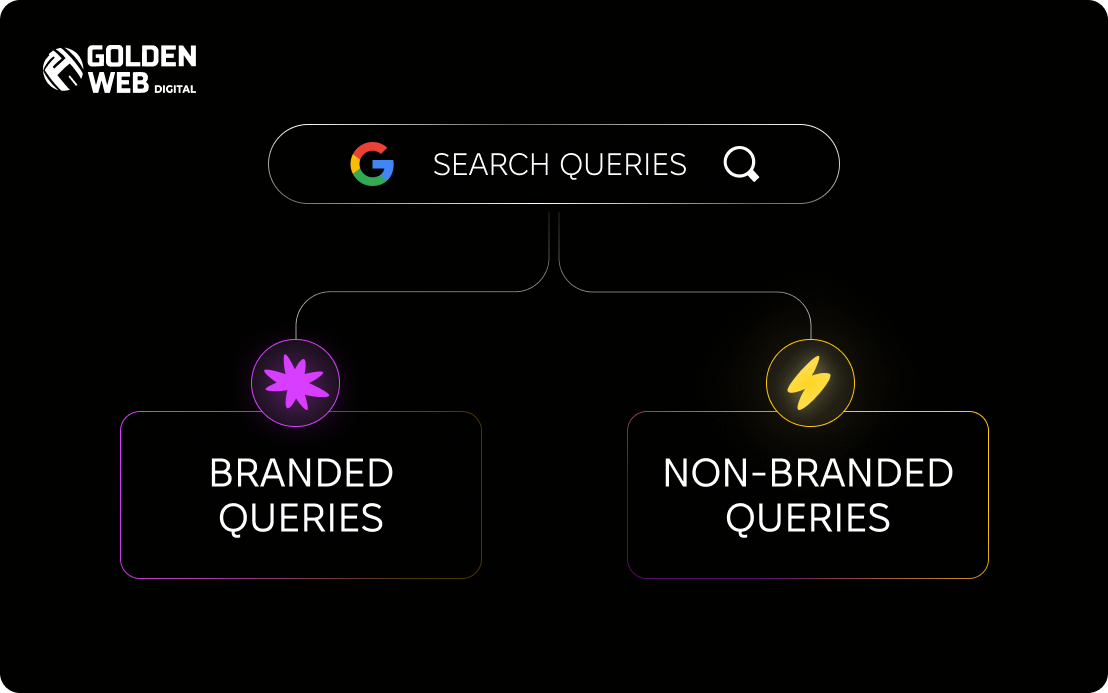
From the perspective of Google’s algorithms (and real-world customer behavior), all search queries fall into two fundamentally different categories. Let’s take a look at the difference between them and why it matters to your bottom line:
- Non-branded queries are searches for a product or service in general. A person is looking for a solution, but does not yet know who to buy it from. For example: “wireless alarm for an apartment”, “development of an online store” or “laptop for work”.
- Branded queries are when a user already knows a company and purposefully enters its name: "Ajax alarm system", "Golden Web Digital SEO" or "Apple MacBook Pro reviews".
By the way, Google itself understands this difference perfectly well. There is even a separate tool in the Google Search Console service — Branded queries filter. Google documentation states a very simple thing: non-branded traffic shows how the site attracts a new audience, and branded traffic — how you work with those who already know you. People click on branded queries much more often, and the positions there are more stable, because the user comes to you consciously, but this filter by itself does not affect the site’s ranking in any way.
Now let's see how this path from random search to purchase works in real life:
- First contact: a person searches Google for “wireless apartment alarm” (a non-branded query) and thanks to SEO, they come across a useful article on the site.
- Getting to know her: she studies the specifications and equipment, but doesn't place an order right away - she decides to think it over.
- Emotional reinforcement: a few days later, she comes across a short Reels on social media demonstrating how convenient it is to control this system via a smartphone app.
- Building trust: a potential buyer learns about the company's values, sees expert video analysis and live user reviews.
- Conscious choice: a week later, when the decision to purchase is finally formed, the person is no longer looking for abstract protection for the home, but opens Google and enters a brand query - "Ajax alarm", goes to the site and places an order.
Here's the secret: SEO became the first bridge to getting to know the business, and high-quality work on social networks turned this nameless search contact into sustainable brand knowledge and led the person to make a purchase.
Why a brand presence on Google is no longer just about a website
Remember the days when Google search was a simple list of 10 blue links? Well, those are long gone. Today, search results are more like interactive showcases, where algorithms present information to the user in a variety of formats.
If your business is represented by only one page in organic search, you are voluntarily giving most of the screen (and therefore the buyer's attention) to your competitors.
Modern comprehensive brand promotion on Google involves presence in all key blocks of the search results:
- classic organic search results;
- company card on Google Maps;
- video blocks and recommendations from YouTube;
- product delivery (Google Shopping);
- image blocks and product galleries;
- generative AI search functions (Search Overview).
The search engine provides many formats for business representation (Search appearances). Your brand's task is not just to "have a website online", but to build a holistic brand presence on Google to cover the maximum number of touchpoints where a potential customer can search for information about your products or services.
SEO and Social Media: Where the Connection Really Is
In fact, SEO and social networks have long been playing on the same team, they just do it on different fields. While SMM creates emotional contact and keeps the business in the field of view of the audience, SEO intercepts the formed interest in the search engine.
What does this support look like in practice?
- Double presence in a customer's life: when a person regularly sees your brand on social media and then finds your website in the top of Google, they have no doubts about the reliability of the company.
- A surge in quality branded traffic: an interesting post or viral Reels makes people search Google for not just an abstract product, but your company.
- A second wind for website content: a new article, detailed analysis, or case study from the website, shared on social media, instantly receives real conversions and hot coverage.
- Natural growth of authority (Link Building): the more actively your content spreads across the network, the more often other websites, bloggers, and media outlets link to it. And live links for Google are one of the main confirmed signals of relevance and quality of a page.
- Social networks themselves are in the lead: your YouTube videos, profiles, or publications themselves feel great in the first positions in search.
This connection has long been an official trend. In July 2026, Google launched the Platform properties tool in Search Console. It allows you to analyze how content from Instagram, TikTok, X, and YouTube is found by users through Google Search, the Discover feed, and Google News.
This very clearly shows that the line between "SEO text" and "social media content" is becoming less rigid - today they work as a single brand content ecosystem.
One brand — many touchpoints: the real customer journey
In real life, people rarely buy from the first random click. If you judge marketing solely by the last click source, you can mistakenly conclude that only one channel works and all others are wasted resources.
In fact, the buyer's journey is multi-channel and consists of several sequential steps:
- First encounter (SEO): A person searches for a solution to their problem on Google and ends up on your site due to a commercial or informational request.
- Study: Reads an article, views a service or case page, and forms a first impression of the company.
- Emotional immersion (SMM): Sees your posts on Instagram or TikTok: gets to know the team, projects, and brand atmosphere.
- Confirmation of expertise: Watch a detailed video analysis or case study on YouTube and be convinced of your expertise.
- Re-contact: Returns to Google and searches directly for your company name.
- Final action: Goes to the site and leaves a request for a product or service.
When you evaluate digital brand promotion as a single chain, it becomes clear: each touchpoint has its role. Eliminate even one step from this chain and a potential customer will simply get lost on the way to the order.
What happens if SEO works without a brand?
Let's imagine a hypothetical situation: you have a website that is perfectly optimized, has separate landing pages for all the necessary keywords, and consistently receives organic traffic from Google.
It would seem that the system works. But if at the same time:
- the brand is almost unknown to your audience;
- social networks are inactive or are maintained “for show”;
- there is no live content communication;
- there is no clear and recognizable identity;
- the user never encounters the company again anywhere else.
In this case, each new contact with a potential client essentially has to start over.
The interaction scenario looks simple. A person can:
find a site → view → close → a month later see a competitor and not even remember the previous company.
That is, SEO generates contact, but by itself does not guarantee brand recall. If you do not work on the name, brand recognition remains at zero, and each new visitor has to be attracted from scratch.
What happens if a brand operates without SEO?
There is also the opposite situation, which can often be observed in the market. A company may have:
- aesthetic and neat Instagram;
- professional visuals and thoughtful, stylish presentation;
- strong, viral Reels with trending images;
- a loyal audience that actively leaves likes and comments.
But at the same time, there is practically no business on Google for queries where people are directly searching for the right thing.
For example, a potential customer searches Google again for “buy leather loafers” or “women’s genuine leather shoes.” If your site isn’t on the first page of search results, she’ll simply go to a competitor and place an order without even knowing about your brand.
As a result, the company is able to work with those who are already familiar with it or who are randomly scrolling through its social media feed, but it loses the hottest traffic — people with an already formed intention to buy here and now.
That is why high-quality, comprehensive business promotion cannot be limited to just one platform or social networks.
The main conclusion of this interaction is very simple:
SEO without a brand limits the development of awareness, and a brand without SEO limits the ability to attract established search demand.
How Brand Management Can Boost SEO Content
The greatest effect occurs when SEO and Brand Management work as a single cross-functional team. At Golden Web Digital Ternopil, we build this interaction on the constant exchange of data and resources.
On the one hand, the Golden Web Digital SEO team knows exactly what users are searching for on Google, which topics are only gaining popularity, and which queries bring in real buyers.
On the other hand, Brand Management has: a content team, live media content, and a deep understanding of the audience's pain points and questions.
When SEO analytics are combined with the creative power of a brand, instead of a standard article, the result is a product that clearly highlights the brand in search results and builds trust.
How does this work in practice?
For example, experts are recording a growing demand for the query: "how to choose a heat pump for your home."
Instead of writing a regular SEO article, the team can create:
- expert material on the website with real photos of the objects;
- a video with an engineer who clearly explains the details and nuances of installation;
- short Reels and informative carousel for Instagram;
- FAQ block created based on live questions and reactions from subscribers.
As a result, one topic turns into a holistic content ecosystem.
And how does SEO help brand management?
Feedback is no less valuable: SEO analytics serves as a powerful source of ideas for social media content planning and audience communication.
The SEO department provides the brand team with accurate market data:
- real search queries of the audience;
- popular questions;
- seasonality and trends;
- topics that are starting to gain demand;
- analysis of branded and non-branded traffic;
- competitors' content gaps.
Thanks to this approach, the content plan for social networks is not formed on the basis of guesswork or painful thoughts of "what should we post today?", but is based on the real information demand of the audience.
By the way, Google itself specifically recommends using Google Trends to analyze search interest in a brand and research the queries that people search for next to its name.
Brand consistency across platforms
A potential client should immediately understand that they are seeing the same company, regardless of where the contact takes place.
To do this, it is important to adhere to a single standard and coordinate among themselves:
- name;
- logotype;
- description of the activity;
- positioning;
- tone of voice;
- visual identity;
- contact information;
- key services.
It is important to maintain this unity on every resource where the business is present, especially:
- website;
- a mark on Google Maps;
- YouTube;
- Instagram;
- TikTok;
- other company profiles.
It is this consistency that helps to form a holistic image of the business and build lasting trust with the audience.
Does a strong brand protect against Google algorithm updates?
Actually, no. Having a recognizable name and high brand demand does not give a site absolute immunity during large-scale Google Core Updates. The search engine regularly changes its ranking systems, so absolutely any resource can fall under temporary fluctuations in positions.
The difference, however, is what happens to businesses during such storms.
If a site lives only on general keywords, any drop in position instantly stops the flow of applications. But for a company with a strong brand, this situation ceases to be a disaster. Even after losing a few steps for non-branded queries, the business continues to receive orders thanks to a stable ecosystem:
- branded search;
- direct links to the site;
- social networks and YouTube, where content continues to warm up the audience;
- Google Maps geoservices, email messages, and mentions on other resources.
As a result, we come to a key conclusion:
The brand does not protect the rating — it makes the digital business model less dependent on a specific rating.
How to measure the connection between SEO and brand development
A simplistic assessment based only on top positions or total organic traffic does not provide a complete understanding of the business result. The true effectiveness of this synergy is revealed only when you analyze both directions in parallel:
From an SEO and search visibility perspective:
- impressions and clicks for non-branded queries;
- overall organic visibility of the site;
- landing page positions in search results;
- the number and quality of conversions from organic traffic.
From a brand and awareness perspective:
- the volume of branded queries and clicks on them;
- CTR indicator for branded phrases;
- the volume of direct traffic to the site;
- overall dynamic interest in the brand in search;
- reach, engagement, content interaction, and user return.
Today, Google Search Console greatly simplifies such analytics: the tool allows you to clearly segment branded and non-branded keywords, and through the platform properties section, evaluate the performance of video and social content.
As a result, the SEO specialist and brand manager rely on a single source of data within the Google ecosystem and build a truly coordinated growth strategy.
SEO + Brand Management at Golden-Web Digital
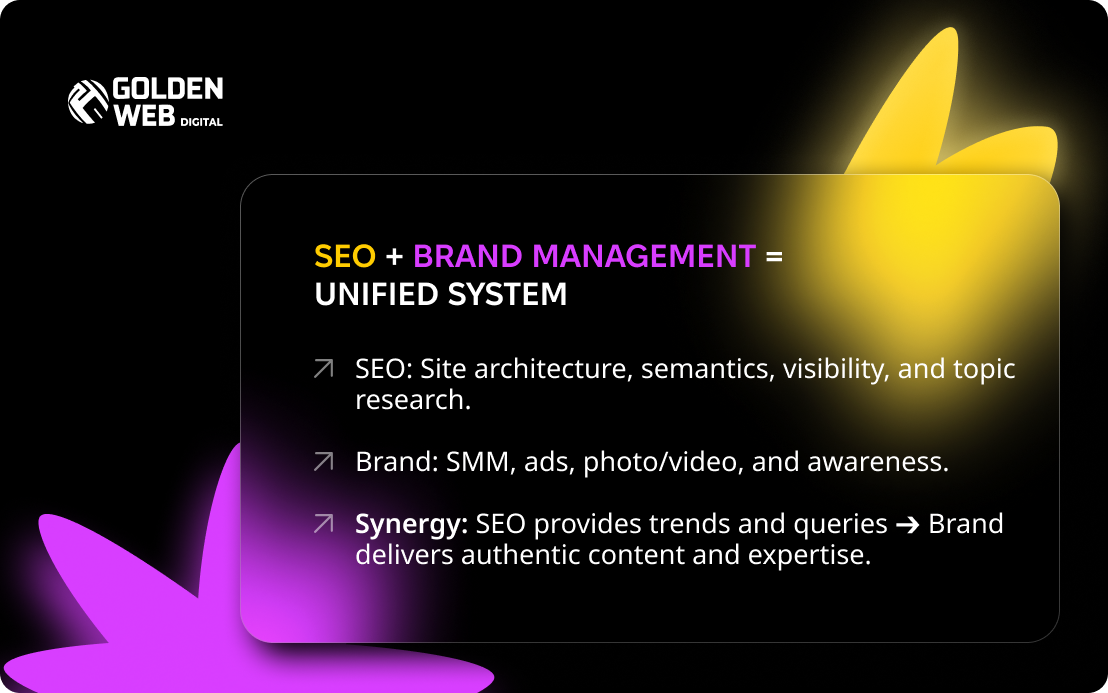
In today's digital environment, SEO and Brand Management should not exist as isolated services. That is why our IT company Golden-Web Digital builds processes so that search engine promotion and brand development work as a single system, where each direction performs its own clear tasks:
- At Golden Web Digital SEO, the team is responsible for site architecture, semantic expansion, technical optimization, organic visibility, and finding new content opportunities.
- Brand Management takes care of communication, content creation, social media development, photo and video shooting, targeted advertising, and increasing awareness.
Instead of lengthy bureaucracy, there is a quick and practical exchange of data between departments:
- SEO → Brand Management: what people are searching for → what questions are growing → what topics are really interesting to the audience.
- Brand Management → SEO: real photos → videos → expert comments → live client questions → own experience → materials for content.
As a result, the website ceases to be just a dry “optimized platform.” It turns into a living center of all brand communication, where a high-quality technical base is supported by real expertise and trust.
Why businesses shouldn't choose between SEO and branding
Trying to contrast SEO and branding and determine which is more important is pointless. These areas are not in competition with each other, but work at different stages of the customer journey.
The interaction between them can be represented in a simple chain model:
- SEO → found
- Content → got it
- Brand → remembered
- Social networks → met again
- Branded search → returned
- Website → converted
If even one link is missing, the overall effectiveness of the promotion drops sharply. So the main question is not in choosing a specific channel, but in how to build a holistic system where search visibility and brand awareness continuously reinforce each other.
This is exactly the kind of systematic approach that the Golden Web Digital Ukraine team implements — we combine deep search demand analytics with strong brand management, creating a stable foundation for long-term business growth.