Django (Python) VS PrestaShop (PHP): let's break down the key differences — Golden Web Digital
The success of a digital project is measured not only by a bright design or a well-thought-out catalog, but also by the technological foundation on which it is built. When a business goes online or plans a large-scale upgrade, a strategic question arises: which technology to choose for an online store or a complex web service? This decision directly affects the speed of page loading, data security, scalability during peak loads, and the ability to implement non-standard functionality.
Today, the market offers two fundamentally different approaches to development. On the one hand, there is PrestaShop, a popular open source CMS platform designed specifically for quickly launching e-commerce. On the other hand, there is Django, a powerful Python web framework designed for designing high-load and customized digital systems. If you are choosing website creation services and are hesitating whether PrestaShop or Django is better, it is worth analyzing the internal architecture and potential of both solutions in detail.
PrestaShop or Django: key criteria for choosing a technological foundation for e-commerce
To make an informed decision, it is important to understand that the tools differ not only in programming language or deployment speed. The use of a ready-made CMS or framework determines the level of freedom of developers, flexibility of customization, behavior of the site under load and features of integration with external services. Therefore, when comparing PrestaShop and Django, one should evaluate not only the initial launch stage, but also the prospects for the development of a digital product for years to come. In such a matter as developing a website for a business, savings at the start can turn into significant limitations in the future.
Architectural flexibility and customization: Django Python development vs. modular PHP
The possibilities of adapting the system to unique business processes differ dramatically depending on the choice of technological foundation:
- PrestaShop: Based on the Symfony framework (PHP) and relies on a modular architecture. For standard e-commerce this is convenient, but any serious deviation from the basic logic of a "typical store" requires writing complex modules or even rewriting the core. Over time, this leads to conflicts between third-party plugins and makes the system unstable with a large number of modifications.
- Django: As a full-fledged framework, it provides absolute freedom in designing business logic. If a project requires a non-standard sales model (for example, product rentals, auctions, complex subscriptions or service configurators), Django Python implements this as a native part of the system without the tedious "struggle" with CMS limitations.
Thus, for a standard product catalog, PrestaShop's modularity may be enough, but when it comes to creating custom sites with unique algorithms, the framework architecture becomes the undisputed leader.
Performance and scalability compared: why developing an online store website on a framework is ahead of a boxed CMS
The system's ability to withstand high traffic and instantly process requests depends on the database architecture and page generation principles:
- PrestaShop: On large catalogs with tens of thousands of items, PrestaShop starts to consume a significant amount of server resources due to the complex database structure and specifics of page generation. The server response speed (TTFB) becomes sensitive to the quality of installed plugins, which often overload the code with unnecessary requests.
- Django: Django is known worldwide for its exceptional ability to handle massive amounts of data. With its optimized ORM, built-in caching, and asynchronous (ASGI) support, the system can easily handle extreme traffic peaks.
When developing an online store website with high traffic and fast page response, Django ensures stable operation regardless of the number of products in the catalog or simultaneous users.
Security, updates, and technical debt: how technology choice affects project stability and security
Reliable protection of customers' personal data and ease of code maintenance are key factors in the longevity of any web resource:
- PrestaShop: Being a popular open CMS, the platform is constantly at the forefront of automated hacker attacks. The main risk area is third-party modules from the Addons marketplace, in which vulnerabilities are regularly found. At the same time, updating the CMS often turns into a complex process that can “break” custom designs or installed plugins.
- Django: Has a reputation as one of the most secure frameworks in the world. Built-in protection mechanisms against SQL injection, XSS and CSRF work at the core level. By creating a site with Django, developers get a clear structure and clean code, which reduces technical debt to a minimum.
Therefore, high core security and code transparency make the framework a reliable choice for long-term projects that are easy to maintain and update without the risk of cascading failures.
Integrations, ecosystem and development opportunities: PrestaShop paid modules vs. the unlimited potential of a Python site
Modern e-commerce requires seamless connectivity with internal accounting systems and advanced automation tools:
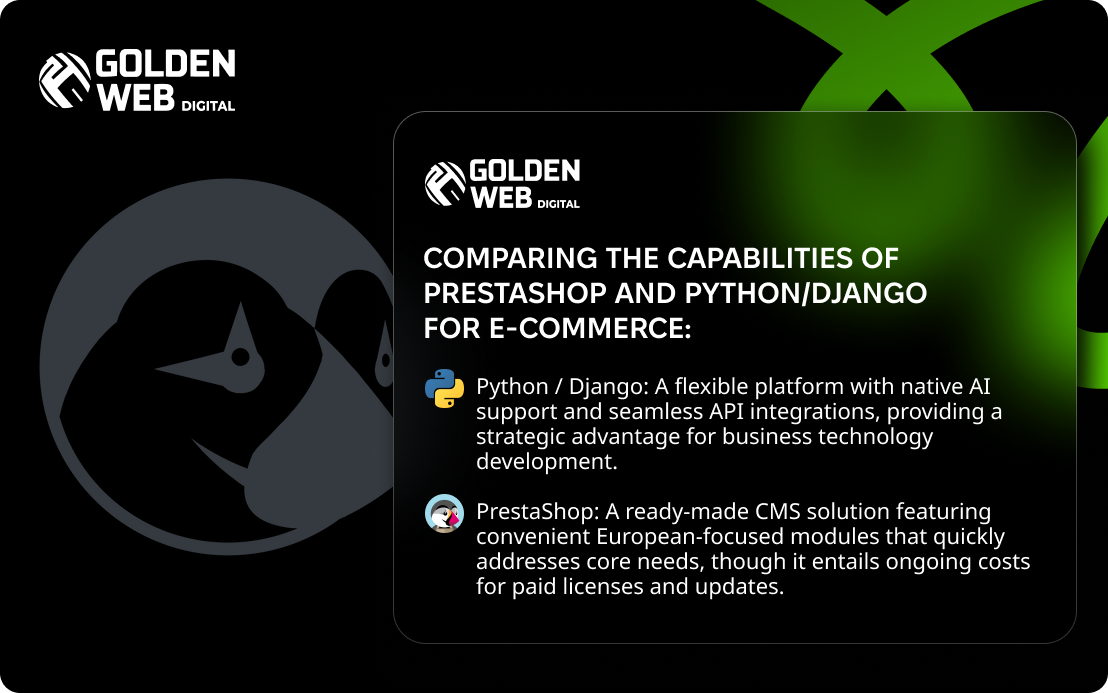
- PrestaShop: Has a large marketplace of ready-made modules for the European market (payment systems, delivery services). However, almost every quality extension is paid and requires regular financial expenses for license renewals and updates.
- Django: Since Python is the undisputed leader in Data Science, Machine Learning, and AI, it opens up unique opportunities. By building a website in Python, you can natively implement intelligent chatbots, personalized recommendation systems, or dynamic pricing based on competitor analysis. Integration with any external API (ERP, CRM, inventory, logistics) is seamless and reliable.
A practical comparison of PrestaShop and Django makes the choice transparent: the ready-made CMS solution covers the needs of standard commerce at the initial stage, while Django gives the business a strategic advantage in flexibility, data protection, and technological development.
How does creating a turnkey website provide a technological advantage for a business?
The choice between a CMS and a framework is primarily based on the strategic goals of the business. For a standard online store with basic functionality and a tight budget, a ready-made platform like PrestaShop will be quite enough. However, if the project requires non-standard business logic, complex integrations, and readiness for high loads, the only right solution will be to create a turnkey site using a flexible architecture based on a framework.
Our team develops modern, secure and high-performance web platforms on Python Django that easily scale with your business. If you need high-quality individual website development - the IT company Golden-Web Digital will help you implement technical tasks of any complexity.
Are you looking for a solution for a start-up from scratch or a system redesign that requires a flexible, turnkey website that grows with your sales? Then it's time to order website development from Golden Web Digital and build a reliable technological foundation for scaling your business.