Why it's important to test, not follow the rules, in PPC advertising
There are many generally accepted rules in the field of PPC marketing: build classic account structures, strictly control keyword match types, scale budgets extremely smoothly, and prevent any overlap between campaigns. In the initial stages, such recommendations really help maintain order in the advertising cabinet and warn against banal mistakes.
However, having a tidy office doesn’t always guarantee maximum profit. Advertising on Google and other platforms is powered by complex machine learning algorithms that process millions of signals, from search intent and user behavior history to conversion and attribution data. Therefore, a solution that may seem counterintuitive to standard guidelines may actually deliver significantly higher returns in a given project.
That's why professional contextual advertising setup is not a one-time setting of the right parameters. It's a constant testing of hypotheses, data analysis, and finding the configuration that best matches real audience behavior and business goals.

Setting up advertising campaigns: how campaign structure, broad match, negative keywords, and impression share affect results
One of the main conclusions of practical testing is that the trend towards total automation does not mean that the detailed account structure has lost its relevance.
Modern advertising systems do indeed process large amounts of data efficiently. However, this does not mean that absolutely all key queries, ads, and sales scenarios should be combined into the most simplified structures possible.
For example, highly profitable or key commercial queries are critical to business margins and can be separated into separate groups or campaigns if necessary. This allows for more flexible budget management, more precise ad targeting, and separate monitoring of the results of such a segment.
Therefore, the settings of advertising campaigns should be built not around the formal rule “the simpler, the better”, but around business goals. If a separate search segment provides the main share of the margin, additional control over it is fully justified even in a well-automated system.
Another controversial topic is broad match. It is often tried to be limited as much as possible due to the risk of spending budget on untargeted traffic. However, completely abandoning broad match deprives the account of promising queries that are difficult to predict at the stage of semantics collection.
A more practical approach is to let the algorithms search for new connections, but shift the focus of control to operational work: regular analysis of actual search terms and expansion of negative keyword lists. In such a model, control is shifted from the initial setup stage to ongoing management of the signals the system receives.
Another example is Target Impression Share. It should not be viewed solely as a brand protection tool. If it is important to your business to consistently dominate search results for key category queries, a high impression share may be more valuable than maximizing the efficiency of a single click.
So, Google contextual advertising should not work according to a single template. One project needs maximum control over structure and semantics, another - more freedom for automatic strategies. Only systematic testing allows to determine the optimal balance.
How to improve Google Ads performance: it's not the number of conversions that matters, but their value
Even a technically flawless campaign can optimize for the wrong result if the system receives incorrect benchmarks.
Let's imagine a situation where a phone call, filling out an application, and clicking on an email are recorded as equivalent conversions in an account. For the algorithm, these are three identical target actions. However, for a real business, their marginality is different: a call can bring a big deal, while a click on an email does not even mean an initial contact.
If all actions have the same weight, the algorithm does not receive a clear enough signal about which users and actions have the most value to the business.
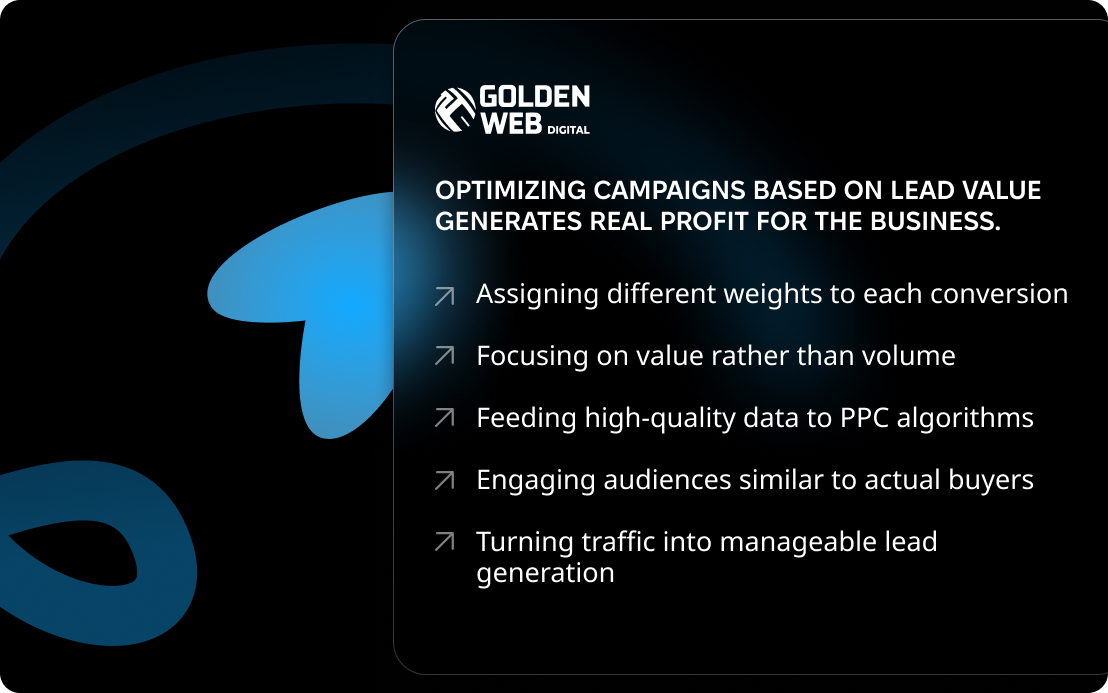
Therefore, the question of how to improve Google Ads performance should be considered through the prism of traffic value, and not just standard metrics like CTR or total number of leads. It is important to provide the advertising system with better data about what exactly generates the company's profit.
To do this, different conversions can be assigned different values depending on their contribution to the business result:
- microconversions (clicks on contacts, views of important pages) receive minimal weight;
- primary treatment - secondary;
- a qualified lead from CRM or a confirmed purchase — maximum value.
As a result, the algorithm gets a clear vector and starts looking for an audience that looks like real buyers. This changes the approach to analytics: 60 high-quality targeted leads can be much more valuable to a business than 100 unspecified applications.
This is how PPC advertising transforms from a simple source of traffic into a managed lead generation system that works for return on investment.
How to optimize your Google Ads campaign: you need to test the entire system
Finding growth points isn’t limited to manipulating bids and keywords. If a business wants to understand how to optimize their Google Ads campaign, it’s worth testing every element of the system—from feed structure and creatives to audience segments and landing pages.
One of the key areas for E-commerce is product campaigns. In Google Shopping and Performance Max, the product feed plays an important role. How products are described, which attributes are listed first, and how structured the data is can affect how the system interprets the product and correlates it with relevant queries.
A simple adjustment to product names in your feed (for example, moving the brand, model, or key feature to the beginning of the Title) can significantly change query relevancy and increase ROI without increasing your advertising budget.
Retargeting is an equally effective testing platform. Since this audience has already interacted with the brand, it responds more quickly to changes in advertising messages. This allows you to quickly check:
- various price offers and promotional offers;
- approaches to removing the client's main objections;
- new visual formats and calls to action (CTAs).
Solutions that show the highest conversion results in retargeting can later be confidently scaled to campaigns to attract new traffic.
This analytical approach covers a wider range of tasks: it's not just Google Ads advertising, but digital marketing in general. System testing allows you to quickly weed out subjective assumptions and leave decisions confirmed by data.
The digital market is constantly changing: algorithms are updated, new formats appear, consumer behavior changes. A strategy that showed high results last year or in another niche will not necessarily work according to a similar pattern today.
Therefore, quality advertising on Google is not a static set of settings. It is a flexible system in which every decision is based on analytics, tested in practice, and adjusted according to actual results.
This is exactly the approach we implement when setting up Google Ads from Golden Web Digital: we dive deep into the client's business processes, analyze primary data, form hypotheses, and test solutions aimed at increasing profits.
The main competitive advantage lies not in blind adherence to formal best practices, but in the ability to find effective connections for a specific project and consistently scale what gives real results.
If you need a systematic approach to advertising with a focus on business indicators, you can always order contextual advertising from the Golden-Web Digital team. We will audit your current campaigns, identify growth points, and build an effective strategy for promoting your project.