Django (Python) VS Drupal: експертний огляд технологій для веб-розробки від Golden-Web Digital
Choosing a technology stack is the foundation that determines the viability of your project for years to come. In this review, we will conduct a detailed comparison of two popular approaches: framework-based development and CMS use. IT specialists from Golden Web Digital will analyze the key differences between configuring ready-made platforms on Drupal and developing self-written systems on Django. We will find out how these approaches affect the speed of creating custom logic, the flexibility of the architecture, and why custom Python site creation is becoming a priority choice for large-scale business solutions.
Flexible architecture and custom logic: why a Django Python site outperforms template CMS
Development efficiency is primarily the absence of artificial barriers. A Django Python website is built on the principle of direct code writing for business needs. As a framework, Django gives the developer complete freedom: unique functions are implemented in the native Python language without intermediaries. This eliminates the "architectural resistance" of the system and speeds up the release.
Instead, a Drupal site works on the principle of configuration. Any non-standard functionality forces you to either look for third-party modules of dubious quality, or adapt your code to the rigid internal APIs and hooks of the CMS. This creates excessive time spent adapting the code to the system.
However, the main differences become apparent when we move on to the "face" of the project — the frontend:
- Drupal's monolithic barrier. Traditionally, this system has a rigid coupling of the backend to the visual part. Even in Decoupled mode, its core generates a lot of redundant HTML/JS code, which significantly complicates technical optimization of loading speed.
- Django's pure architecture. The framework adheres to the principle of complete separation of logic and presentation. It is an ideal basis for Headless solutions, where Django acts as a stable API, and the frontend is implemented on modern stacks (React/Vue), which ensures maximum speed and ideal Core Web Vitals performance.
So, by choosing to order a website creation on Django, you get complete technical independence and an architecture ready to scale, while Drupal often forces businesses to adapt to the rigid framework of a CMS and make compromises with functionality.
Project support and system stability: why building turnkey sites in Python wins the battle for code viability over Drupal
When it comes to building turnkey websites, ease of maintenance becomes a decisive factor. Python code is much easier to read due to its clean syntax. Finding a developer who understands the Django architecture is much easier than finding a “Drupalist” who understands the complex interaction of dozens of modules in an outdated admin panel.
Long-term exploitation of the resource inevitably runs into the problem of the so-called update hell, where technologies demonstrate opposite results:
 In CMS: A major Drupal core update often turns into a lottery. Updating one component can cause the payment module to fail or language version conflicts.
- Django: A philosophy of stability prevails. A clear LTS (Long Term Support) release schedule ensures that code developed today will remain relevant and secure in 3-5 years without the need for a major rewrite of the system.
Choosing Django minimizes technical risks, allowing businesses to invest in new functionality rather than endlessly "repairing" the site after another update.
Scaling and working with data: why a Django site handles complex queries faster than Drupal
If your project requires the development of a corporate website with complex analytics or mathematical models (for example, dynamic pricing), a Django website will handle this easily. Complex logic here is written as a direct function, while in Drupal you will have to literally "fight your way" through the system's complex API.
This flexibility in writing code is supported by powerful database tools. Django has one of the most advanced ORM systems in the world, which allows you to perform complex data retrieval almost instantly. On the other hand, the Drupal architecture, which is inherent in most CMSs, can significantly slow down on large amounts of information due to its overly complex table structure.
Golden Web Digital's Amanda breaks down all the key differences between Django (Python) VS Joomla (PHP-based CMS)
Next-generation website development: asynchrony and system control vs. conservative approaches Drupal
Modern web development requires high interactivity. Django supports asynchronous requests (ASGI), which allows you to process chats, notifications, or heavy file uploads in parallel without blocking the user's work. Drupal remains more conservative and limited in this regard.
This technical advantage becomes strategic when it comes to full ownership of the code. Building a custom site using the Django framework means you own 100% of the intellectual property of the product, rather than simply customizing a ready-made system. You gain full control over the architecture and are no longer dependent on where the CMS developers will turn their development vector in the next release.
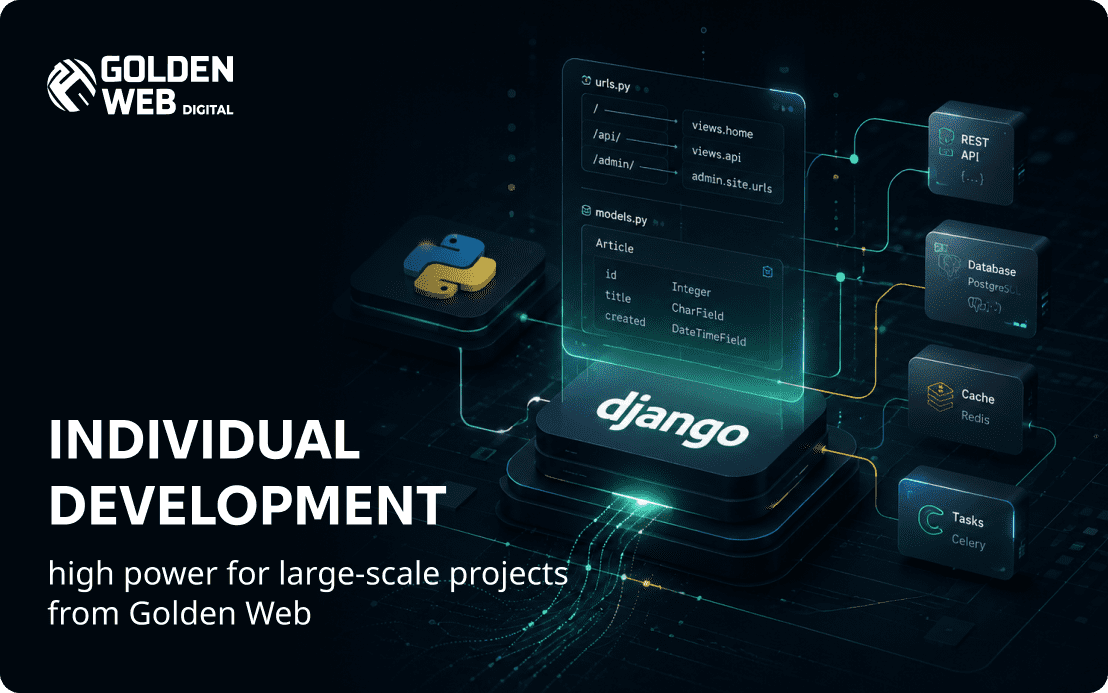
Are you planning to order website development? Golden Web Digital: we create flexible digital assets that go beyond typical solutions
For those planning to order website development, the choice between Drupal and Django depends primarily on the project's ambitions and development strategy. If your business prioritizes unlimited scalability, the highest performance, and architectural security, the Django framework will be the most justified and far-sighted solution. It allows you to create not just a website, but a flexible digital asset ready for any load.
Golden-Web Digital's professional turnkey website development is a combination of deep technical expertise and understanding of the client's business objectives. If you need custom website development that goes beyond standard templates, our team will create an effective and stable product that will work for your company's long-term results.