Optimization and launch of Google Ads for the online coffee and coffee equipment store Royal Life
About the client — https://royal-life.ua/
Domain age — from 2022-06-15
The term of cooperation is from January 2023 to the present.
The site is located on the platform - "Khoroshop"
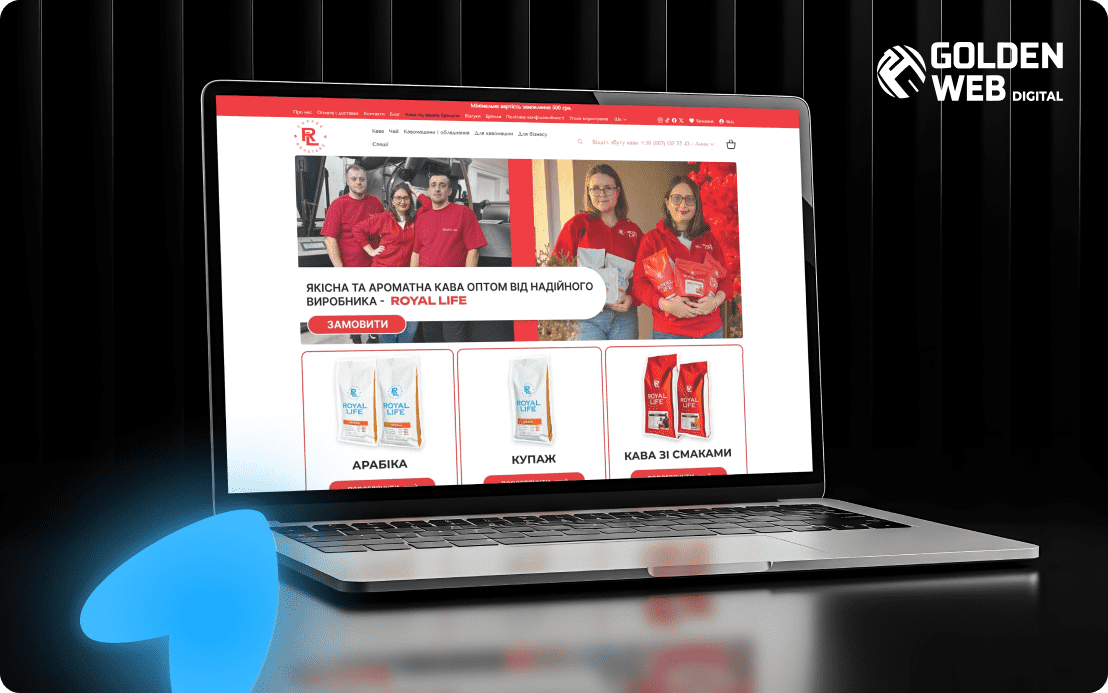
Royal-Life is a Ukrainian manufacturer and online store of natural coffee and coffee equipment. The company operates a full cycle: from the selection of green beans and roasting to blending and packaging of the finished product. The assortment includes everything for coffee drinks: from coffee beans and blends to coffee machines, coffee grinders and accessories.
Project goals and challenges: how Google Ads Royal-Life prepared for the relaunch
In early 2023, Royal-Life turned to Golden Web to transform Google Ads into a stable and manageable sales channel. It was necessary to “remove the chaos” in the existing settings, increase efficiency, and prepare advertising for scaling. To make Google Ads profitable, we identified the following goals.
Main tasks:
 optimize existing campaigns that were working unstable and did not produce the predicted results;
 - launch new campaigns for key product categories (coffee and coffee equipment);
- build a system where budgets and results are controlled, and scaling does not lead to a "drain" of funds.
At the time of launch, the project was "raw" in terms of systemic growth: the site did not have a full-fledged SEO foundation, and it also lacked a structured design for sales - a clear logic of categories and landing pages that would cover various audience requests. Because of this, Google Ads advertising was almost not reinforced by organic traffic, and it was more difficult for users to quickly find the desired product and make a purchase.
In parallel with the launch and optimization of Google Ads, the SEO team joined the work: they began to work on semantics, catalog structure, and landing pages. This was important in order to gradually increase organic advertising traffic, because professional advertising on Google always works much more effectively in synergy with search engine optimization, which allows you to give users the best relevant pages for different groups of queries.
How the GWD team started working on the site: a full inventory and setup of Royal-Life advertising campaigns
We started working on the Royal-Life account by taking inventory and auditing all the campaigns that had accumulated in the account during previous periods. The system had a “hodgepodge” of different types of campaigns: Search, Shopping/Smart Shopping, DSA, CMS (banner/remarketing), Smart campaigns, as well as campaigns for different languages/targets (UA/RU) and individual products (coffee, coffee machines, rentals, etc.). Setting up Google Ads at that time required a complete review. Some campaigns were active, some were paused, but overall the structure looked overloaded and uneven.
Due to the lack of a unified logic, campaigns were not divided by category and role in the funnel, so the budget was “spread” between coffee and equipment, and the results were difficult to control and predict. High-quality setup of advertising campaigns was impossible without eliminating chaos. In essence, the account worked without a clear priority: what exactly should be scaled, and what should be supported/caught up with the user with remarketing.
What we saw during the audit (key issues):
- excessive number of campaigns and budget fragmentation between many areas;
- coffee / equipment / rent mixed in one “pool” → different check and different CPA/ROAS expectations;
- parallel campaigns for similar queries (DSA + Search + Smart) → internal competition and chaotic traffic distribution;
- different languages/structures (UA/RU) without a clear strategy → it is more difficult to manage the relevance and quality of traffic;
- Some campaigns did not provide stable value, but "ate up" the budget or made it difficult to train algorithms.
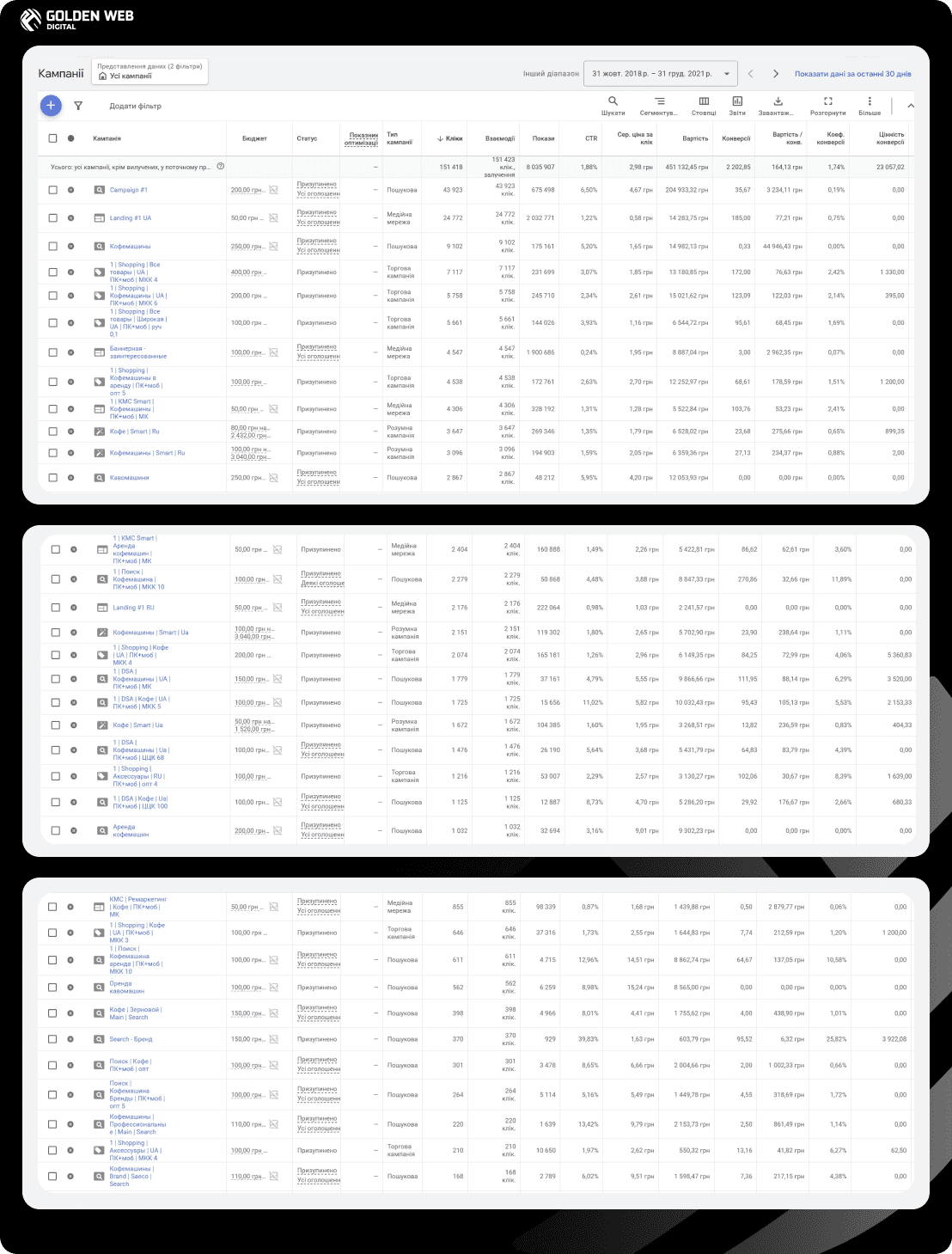
The first step was to completely disassemble the account: we reviewed all active and paused campaigns, structure, settings, and budget allocation. Then we checked the entire analytical base — conversions/goals, tracking accuracy, links to analytics, as well as existing audiences and their logic (remarketing, behavioral segments, lists). This gave us an understanding of what exactly works, what hinders optimization, and where data and efficiency are being lost.
After that, we moved on to practical changes: we stopped everything that existed to eliminate the chaotic "spill" of the budget and internal competition between campaigns. Then we built an updated, manageable structure for key categories and business goals - and Google Ads advertising was reconfigured from scratch: with correct segmentation, transparent priorities, controlled budgets, and a basis for further optimization and scaling.
Switching to max performance and comprehensive site optimization (January 2023 → until now)
Start of cooperation: preparation for the transition Smart Shopping → Performance Max
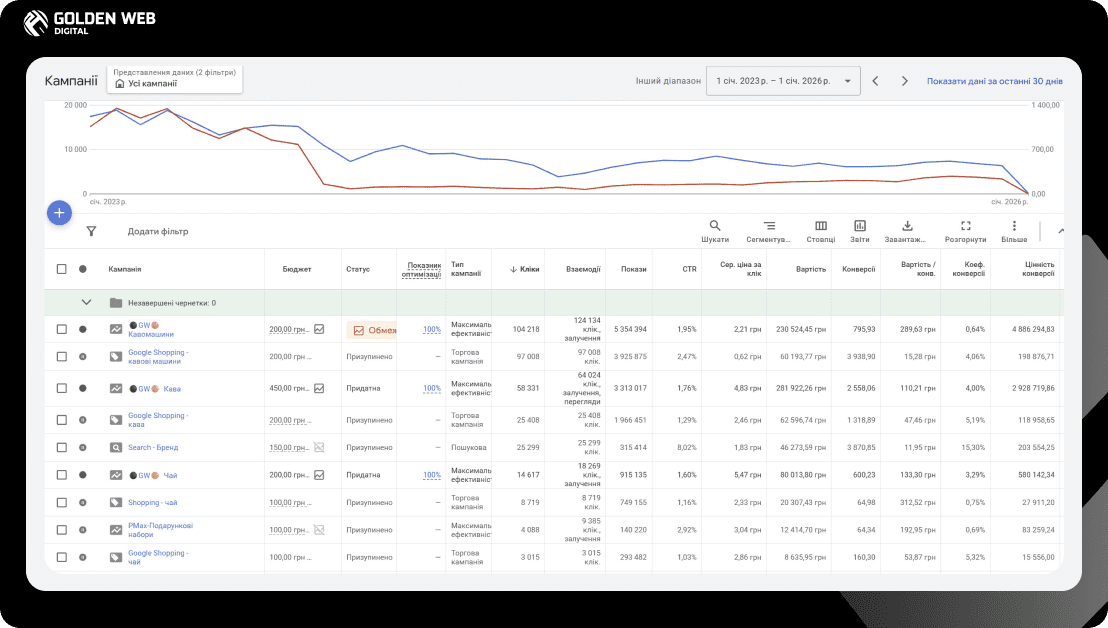
Cooperation with Royal-Life started in January 2023, when Google had already announced the automatic transition of Smart Shopping campaigns to Performance Max. After agreement with the client, we decided to act in advance - we made the transition to max performance and comprehensive site optimization helped us maintain sales dynamics. We launched google performance max in parallel with the existing Smart Shopping/Shopping in order to collect data in advance and “train” the new type of campaigns. The goal was simple: not to lose the results that Smart Shopping was already bringing during the upcoming migration.
Since max performance was in its early stages (beta) at that time, we did not risk a sharp budget shift and continued to actively work with standard Shopping campaigns as a more stable tool.
Therefore, Shopping + Performance Max worked in parallel
In one of the key product categories, we tested the approach of using standard Google Shopping and Performance Max in parallel. Later, we tested the approach using only Performance Max. To do this, we paused Shopping and left a few key campaigns running, on which we shifted our main focus. Then we began to actively optimize them: we worked with assortment, audience signals, budgets and creative quality to achieve stable results and understand whether PMax could completely replace Shopping.
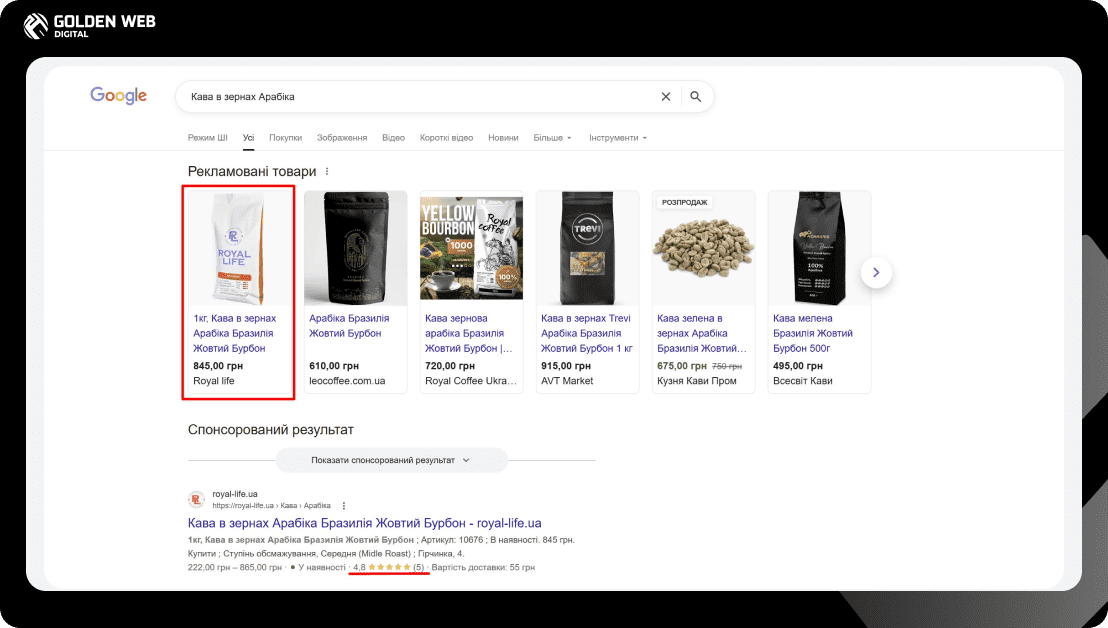
Throughout the entire period of work, we approached the project comprehensively — not only as a way to set up contextual advertising, but as a way to build strong online sales. In parallel with managing Google Ads, the SEO team actively worked on the design and style of the site, strengthening branding and a unified presentation of the company, so that the user from the advertisement would get to pages that inspire trust and motivate them to buy.
A lot of attention was paid to reviews and reputation: feedback was systematically collected and processed, social proof and buyer confidence were increased. As a result, this gave a "bundle" effect - the site became clearer for the client, and SEO optimization of the site allowed us to significantly improve our positions in organic search results. That is, we simultaneously strengthened two marketing channels, where PPC advertising was the main tool for obtaining quick conversions.
In parallel with these changes, we systematically conducted the advertising campaigns themselves - in a clear order of optimizations to maintain efficiency and gradually improve the result. On an ongoing basis, we:
- we exclude ineffective products from displays so that the budget is not spent on items without payback;
- we add new groups of objects to Performance Max with new audience signals and test different approaches to campaign training;
- we suspend less effective groups of objects, leaving those that provide stable conversions and income in operation;
- We adjust campaign strategies: we periodically change the target ROAS or even the strategy itself (focusing on the value of conversions or the number of conversions) - depending on the tasks for the period and demand behavior.
We are currently additionally testing new audience signals, and for better performance of campaigns in specific categories, we are optimizing the product feed: we are checking segmentation by product cost and improving descriptions. Since proper SEO optimization of product cards directly affects results, we are working on content to enhance the relevance and quality of impressions in PMax.
For the coffee machine category (sale and rental), we separately optimized geography and left impressions on Kyiv. In practice, Kyiv provided the best quality leads and more stable conversions — not only in sales, but also in rental applications. Thanks to this, we reduced the “dispersion” of the budget on regions with a lower probability of purchase/rental and concentrated spending where demand and conversion rates were higher.
PPC advertising and SEO site optimization: synergy analysis and results for the last 3 months (October–December 2025)
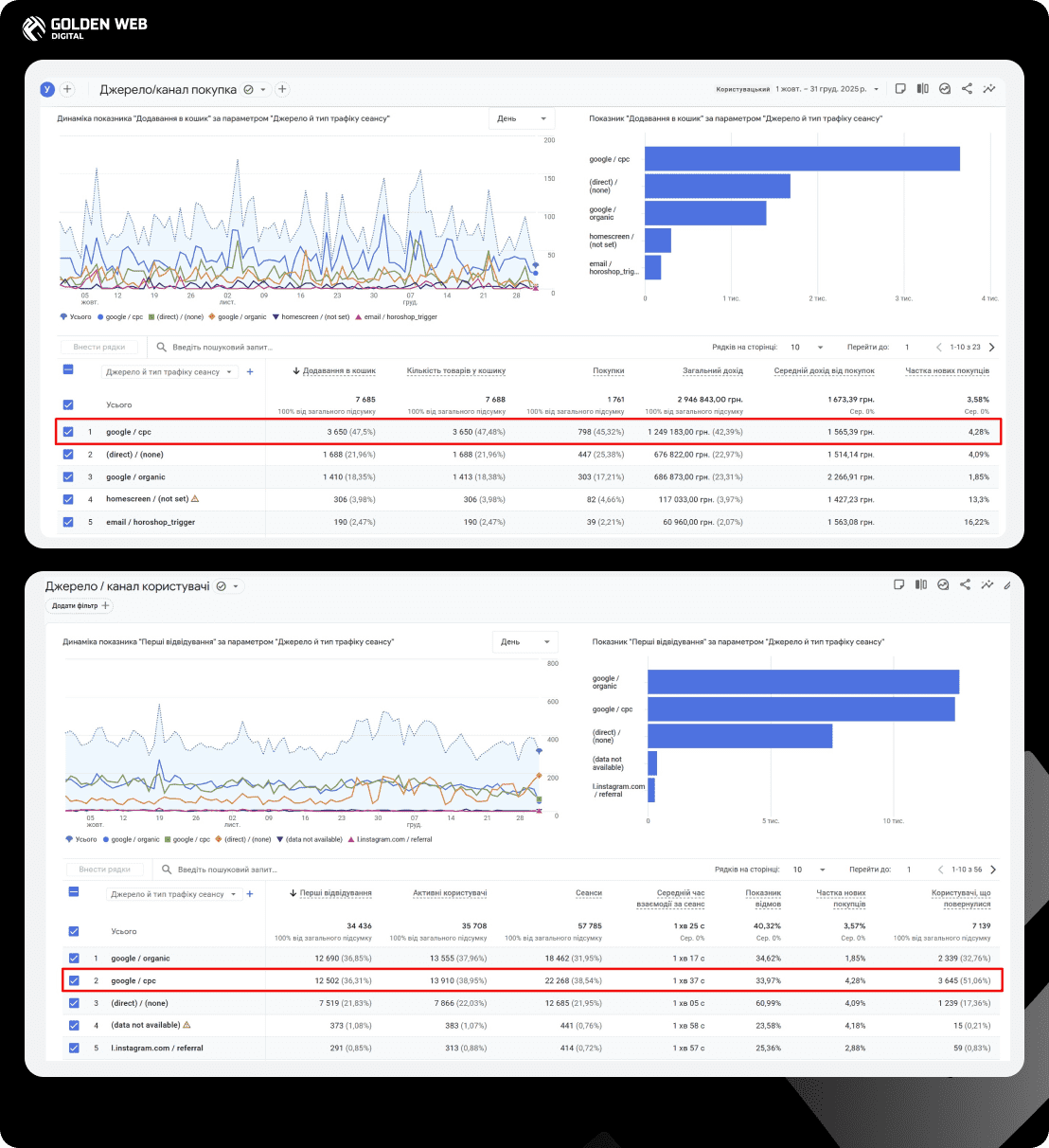
And what do we have after years of continuous PPC + SEO working together — the channels have really started to reinforce each other. SEO → brings people to the top of the funnel, PPC → gives them a faster path to purchase The user report shows that SEO and PPC almost equally form “first visits”:
- google / organic: 12,690 first visits (36.85%)
- google/cpc: 12,502 first visits (36.31%)
That is, organics consistently bring new people, and advertising also actively brings new users to the store. At the same time, PPC gives deeper traffic:
- sessions with google/cpc more: 22,268 (38.54%) vs. 18,462 (31.95%) with organic
- average interaction time is higher in cpc: 1 min 37 s compared to 1 min 17 s
- the bounce rate in cpc is also better/stable (around 34%)
This usually means: that the sales funnel is correctly formed here. SEO gives a valuable effect - strong purchases and trust (visible by the average check) Organic (google/organic) gives fewer purchases than cpc, but pay attention to the average revenue per purchase:
- google/organic: 2,266.91 UAH (highest check)
- google/cpc: 1,565.39 UAH
This is a very typical and powerful story: SEO builds trust/expertise/brand, people come to get acquainted and are more likely to buy more expensively or with a larger basket.
The shopping/cart report shows that Google Ads (google/cpc) is the key channel by purchase intent:
- Adding to Cart: 3,650 (47.5% of total 7,685)
- Purchases: 798 (45.32% of all 1,761)
- Income: UAH 1,249,183 (42.39% of UAH 2,946,843)
That is, PPC here works as the basis of the bottom of the funnel: the most carts and the most transactions.
How did contextual advertising settings and SEO optimization from Golden Web increase revenue with an unchanged budget of 850 UAH/day? Comparison 2024 → 2025
The most valuable thing in this comparison is that we did not raise the budget or make any drastic changes in expenses: we worked with a stable 850 UAH/day throughout the entire period. But in 2025 we managed to make advertising much more effective - due to the structure, traffic cleaning, and system optimizations. That is, we began to get more results from the same hryvnia. This is clearly visible in the key metrics:
- Purchases increased by +70.83%: 779 versus 456 — meaning that advertising began to generate significantly more orders without increasing the budget.
- Revenue increased by +27.3%: UAH 1,227,123 versus UAH 963,993 — with the same expenses, the business received significantly more revenue.
- CPA decreased by -41.4%: UAH 98.92 versus UAH 168.81 — each purchase became almost one and a half times cheaper.
- ROAS increased by +27.16%: 15.92 versus 12.52 — the return on investment has become higher, meaning advertising is working for profitability.
At the same time, clicks decreased by -6.44% (20,634 vs 22,054), but the result increased — this means that we removed some of the non-targeted traffic and left higher-quality conversions that are more likely to convert into purchases.
In fact, in 2025 we went from a “more traffic” approach to a “more sales” approach, and we did it on the same budget — this is what strong optimization looks like when advertising becomes manageable and predictable.
In this case, we actually implemented a SEM strategy (Search Engine Marketing) — this is a comprehensive search promotion that combines search engine optimization marketing (organic positions) and PPC/Google Ads (paid campaigns), building stable traffic for the future. Over the years of working together, we have leveled the funnel: SEO increased the visibility of the brand and categories, provided a more systematic influx of new users, and increased the level of trust in the store. At the same time, Google Ads monetized this demand as quickly as possible — brought in target buyers, returned the audience with remarketing, and gave a controlled result even in difficult seasonal periods.
If you want the same advertising setup in Google Ads, Golden Web Digital will help you build an SEM strategy for your business: we will conduct an audit, put together the correct advertising and SEO structure, and systematically optimize so that you grow steadily in search.
Write to us — we will choose the best promotion plan for your niche. Don't waste your time and opportunity to order contextual advertising from Golden-Web Digital to turn your website into a powerful sales tool.
About the client — https://royal-life.ua/
Domain age — from 2022-06-15
The term of cooperation is from January 2023 to the present.
The site is located on the platform - "Khoroshop"
Royal-Life is a Ukrainian manufacturer and online store of natural coffee and coffee equipment. The company operates a full cycle: from the selection of green beans and roasting to blending and packaging of the finished product. The assortment includes everything for coffee drinks: from coffee beans and blends to coffee machines, coffee grinders and accessories.
Project goals and challenges: how Google Ads Royal-Life prepared for the relaunch
In early 2023, Royal-Life turned to Golden Web to transform Google Ads into a stable and manageable sales channel. It was necessary to “remove the chaos” in the existing settings, increase efficiency, and prepare advertising for scaling. To make Google Ads profitable, we identified the following goals.
Main tasks:
- optimize existing campaigns that were working unstable and did not produce the predicted results;
- launch new campaigns for key product categories (coffee and coffee equipment);
- build a system where budgets and results are controlled, and scaling does not lead to a "drain" of funds.
At the time of launch, the project was "raw" in terms of systemic growth: the site did not have a full-fledged SEO foundation, and it also lacked a structured design for sales - a clear logic of categories and landing pages that would cover various audience requests. Because of this, Google Ads advertising was almost not reinforced by organic traffic, and it was more difficult for users to quickly find the desired product and make a purchase.
In parallel with the launch and optimization of Google Ads, the SEO team joined the work: they began to work on semantics, catalog structure, and landing pages. This was important in order to gradually increase organic advertising traffic, because professional advertising on Google always works much more effectively in synergy with search engine optimization, which allows you to give users the best relevant pages for different groups of queries.
How the GWD team started working on the site: a full inventory and setup of Royal-Life advertising campaigns
We started working on the Royal-Life account by taking inventory and auditing all the campaigns that had accumulated in the account during previous periods. The system had a “hodgepodge” of different types of campaigns: Search, Shopping/Smart Shopping, DSA, CMS (banner/remarketing), Smart campaigns, as well as campaigns for different languages/targets (UA/RU) and individual products (coffee, coffee machines, rentals, etc.). Setting up Google Ads at that time required a complete review. Some campaigns were active, some were paused, but overall the structure looked overloaded and uneven.
Due to the lack of a unified logic, campaigns were not divided by category and role in the funnel, so the budget was “spread” between coffee and equipment, and the results were difficult to control and predict. High-quality setup of advertising campaigns was impossible without eliminating chaos. In essence, the account worked without a clear priority: what exactly should be scaled, and what should be supported/caught up with the user with remarketing.
What we saw during the audit (key issues):
- excessive number of campaigns and budget fragmentation between many areas;
- coffee / equipment / rent mixed in one “pool” → different check and different CPA/ROAS expectations;
- parallel campaigns for similar queries (DSA + Search + Smart) → internal competition and chaotic traffic distribution;
- different languages/structures (UA/RU) without a clear strategy → it is more difficult to manage the relevance and quality of traffic;
- Some campaigns did not provide stable value, but "ate up" the budget or made it difficult to train algorithms.
The first step was to completely disassemble the account: we reviewed all active and paused campaigns, structure, settings, and budget allocation. Then we checked the entire analytical base — conversions/goals, tracking accuracy, links to analytics, as well as existing audiences and their logic (remarketing, behavioral segments, lists). This gave us an understanding of what exactly works, what hinders optimization, and where data and efficiency are being lost.
After that, we moved on to practical changes: we stopped everything that existed to eliminate the chaotic "spill" of the budget and internal competition between campaigns. Then we built an updated, manageable structure for key categories and business goals - and Google Ads advertising was reconfigured from scratch: with correct segmentation, transparent priorities, controlled budgets, and a basis for further optimization and scaling.
Switching to max performance and comprehensive site optimization (January 2023 → until now)
Start of cooperation: preparation for the transition Smart Shopping → Performance Max
Cooperation with Royal-Life started in January 2023, when Google had already announced the automatic transition of Smart Shopping campaigns to Performance Max. After agreement with the client, we decided to act in advance - we made the transition to max performance and comprehensive site optimization helped us maintain sales dynamics. We launched google performance max in parallel with the existing Smart Shopping/Shopping in order to collect data in advance and “train” the new type of campaigns. The goal was simple: not to lose the results that Smart Shopping was already bringing during the upcoming migration.
Since max performance was in its early stages (beta) at that time, we did not risk a sharp budget shift and continued to actively work with standard Shopping campaigns as a more stable tool.
Therefore, Shopping + Performance Max worked in parallel
In one of the key product categories, we tested the approach of using standard Google Shopping and Performance Max in parallel. Later, we tested the approach using only Performance Max. To do this, we paused Shopping and left a few key campaigns running, on which we shifted our main focus. Then we began to actively optimize them: we worked with assortment, audience signals, budgets and creative quality to achieve stable results and understand whether PMax could completely replace Shopping.
Throughout the entire period of work, we approached the project comprehensively — not only as a way to set up contextual advertising, but as a way to build strong online sales. In parallel with managing Google Ads, the SEO team actively worked on the design and style of the site, strengthening branding and a unified presentation of the company, so that the user from the advertisement would get to pages that inspire trust and motivate them to buy.
A lot of attention was paid to reviews and reputation: feedback was systematically collected and processed, social proof and buyer confidence were increased. As a result, this gave a "bundle" effect - the site became clearer for the client, and SEO optimization of the site allowed us to significantly improve our positions in organic search results. That is, we simultaneously strengthened two marketing channels, where PPC advertising was the main tool for obtaining quick conversions.
In parallel with these changes, we systematically conducted the advertising campaigns themselves - in a clear order of optimizations to maintain efficiency and gradually improve the result. On an ongoing basis, we:
- we exclude ineffective products from displays so that the budget is not spent on items without payback;
- we add new groups of objects to Performance Max with new audience signals and test different approaches to campaign training;
- we suspend less effective groups of objects, leaving those that provide stable conversions and income in operation;
- We adjust campaign strategies: we periodically change the target ROAS or even the strategy itself (focusing on the value of conversions or the number of conversions) - depending on the tasks for the period and demand behavior.
We are currently additionally testing new audience signals, and for better performance of campaigns in specific categories, we are optimizing the product feed: we are checking segmentation by product cost and improving descriptions. Since proper SEO optimization of product cards directly affects results, we are working on content to enhance the relevance and quality of impressions in PMax.
For the coffee machine category (sale and rental), we separately optimized geography and left impressions on Kyiv. In practice, Kyiv provided the best quality leads and more stable conversions — not only in sales, but also in rental applications. Thanks to this, we reduced the “dispersion” of the budget on regions with a lower probability of purchase/rental and concentrated spending where demand and conversion rates were higher.
PPC advertising and SEO site optimization: synergy analysis and results for the last 3 months (October–December 2025)
And what do we have after years of continuous PPC + SEO working together — the channels have really started to reinforce each other. SEO → brings people to the top of the funnel, PPC → gives them a faster path to purchase The user report shows that SEO and PPC almost equally form “first visits”:
- google / organic: 12,690 first visits (36.85%)
- google/cpc: 12,502 first visits (36.31%)
That is, organics consistently bring new people, and advertising also actively brings new users to the store. At the same time, PPC gives deeper traffic:
- sessions with google/cpc more: 22,268 (38.54%) vs. 18,462 (31.95%) with organic
- average interaction time is higher in cpc: 1 min 37 s compared to 1 min 17 s
- the bounce rate in cpc is also better/stable (around 34%)
This usually means: that the sales funnel is correctly formed here. SEO gives a valuable effect - strong purchases and trust (visible by the average check) Organic (google/organic) gives fewer purchases than cpc, but pay attention to the average revenue per purchase:
- google/organic: 2,266.91 UAH (highest check)
- google/cpc: 1,565.39 UAH
This is a very typical and powerful story: SEO builds trust/expertise/brand, people come to get acquainted and are more likely to buy more expensively or with a larger basket.
The shopping/cart report shows that Google Ads (google/cpc) is the key channel by purchase intent:
- Adding to Cart: 3,650 (47.5% of total 7,685)
- Purchases: 798 (45.32% of all 1,761)
- Income: UAH 1,249,183 (42.39% of UAH 2,946,843)
That is, PPC here works as the basis of the bottom of the funnel: the most carts and the most transactions.
How did contextual advertising settings and SEO optimization from Golden Web increase revenue with an unchanged budget of 850 UAH/day? Comparison 2024 → 2025
The most valuable thing in this comparison is that we did not raise the budget or make any drastic changes in expenses: we worked with a stable 850 UAH/day throughout the entire period. But in 2025 we managed to make advertising much more effective - due to the structure, traffic cleaning, and system optimizations. That is, we began to get more results from the same hryvnia. This is clearly visible in the key metrics:
- Purchases increased by +70.83%: 779 versus 456 — meaning that advertising began to generate significantly more orders without increasing the budget.
- Revenue increased by +27.3%: UAH 1,227,123 versus UAH 963,993 — with the same expenses, the business received significantly more revenue.
- CPA decreased by -41.4%: UAH 98.92 versus UAH 168.81 — each purchase became almost one and a half times cheaper.
- ROAS increased by +27.16%: 15.92 versus 12.52 — the return on investment has become higher, meaning advertising is working for profitability.
At the same time, clicks decreased by -6.44% (20,634 vs 22,054), but the result increased — this means that we removed some of the non-targeted traffic and left higher-quality conversions that are more likely to convert into purchases.
In fact, in 2025 we went from a “more traffic” approach to a “more sales” approach, and we did it on the same budget — this is what strong optimization looks like when advertising becomes manageable and predictable.
In this case, we actually implemented a SEM strategy (Search Engine Marketing) — this is a comprehensive search promotion that combines search engine optimization marketing (organic positions) and PPC/Google Ads (paid campaigns), building stable traffic for the future. Over the years of working together, we have leveled the funnel: SEO increased the visibility of the brand and categories, provided a more systematic influx of new users, and increased the level of trust in the store. At the same time, Google Ads monetized this demand as quickly as possible — brought in target buyers, returned the audience with remarketing, and gave a controlled result even in difficult seasonal periods.
If you want the same advertising setup in Google Ads, Golden Web Digital will help you build an SEM strategy for your business: we will conduct an audit, put together the correct advertising and SEO structure, and systematically optimize so that you grow steadily in search.
Write to us — we will choose the best promotion plan for your niche. Don't waste your time and opportunity to order contextual advertising from Golden-Web Digital to turn your website into a powerful sales tool.