Keywords and Search Queries
We analyze the actual searches that cause users to see and click ads.
We exclude irrelevant traffic, expand the keyword list, and refine keyword targeting.
Google Ads advertising helps attract users at the very moment they are searching for a product, service, or solution. However, advertising performance depends on more than just setting up campaigns correctly at the start.
Search demand, competition, cost per click, and audience behavior are constantly changing. That is why professional Google Ads management is an ongoing cycle:
analysis → setup → launch → data collection → optimization → growth.
At Golden Web Digital, we analyze the business, industry, audience, competitive landscape, and previous marketing efforts before launching. Based on these insights, we develop the campaign structure and determine how Google Ads can support each project’s specific business objectives.
Golden Web Digital is an official Google Partner. Our Partner status confirms our team’s expertise in Google advertising products and compliance with the Google Partners program requirements.
PPC advertising is a form of paid online advertising that allows ads to be shown to users based on their search queries, interests, behavior, and other signals.Its main value for businesses is the ability to reach existing demand: users are already searching for a specific product or service, and ads help a company appear among the options they consider.
For example,PPC advertising for a websitecan direct users to:
But a website visit is only an intermediate metric.
For businesses, what matters more may bean inquiry, a call, an appointment, a booking, a purchase, or revenue generated by ads. That is why we start not with ads, but with understanding which desired action we need to achieve.
Setup involves more than creating a few campaigns and turning on ads. Before launching, it is important to research demand, build an account structure, set advertising priorities, prepare analytics, and establish the conditions for accurately measuring performance.
We examine:
If Google Ads campaigns have already been run, we review the advertising account and historical performance data to determine which insights and assets can be reused.
For one project, the primary goal may be a sale; for another, it may be an inquiry, phone call, appointment, or another conversion action.
Before launch, we define:
This allows us to evaluate campaigns not just by clicks, but by the business results they deliver.
We structure Google Ads campaigns to make them easy to manage and their performance easy to analyze.
Campaigns can be segmented by:
We select relevant keywords, ad copy, and landing pages for each group.
We research keywords, develop ad messages, define audiences, locations, and other targeting parameters.
Ads should do more than include keywords: they must match user intent and accurately communicate the business offer.
Before launch, we check whether the required conversion actions can be tracked accurately.
Depending on the project, this may include:
Without accurate analytics, it is difficult to determine which campaigns generate valuable actions and where the advertising budget should be allocated.
We determine the bidding and budgeting approach based on the goals, available performance data, and specifics of the project.
Depending on the situation, we may use CPA, ROAS, Maximize Conversions, CPC, or another bidding strategy.
After that, welaunch the PPC campaignsand begin collecting actual performance data.
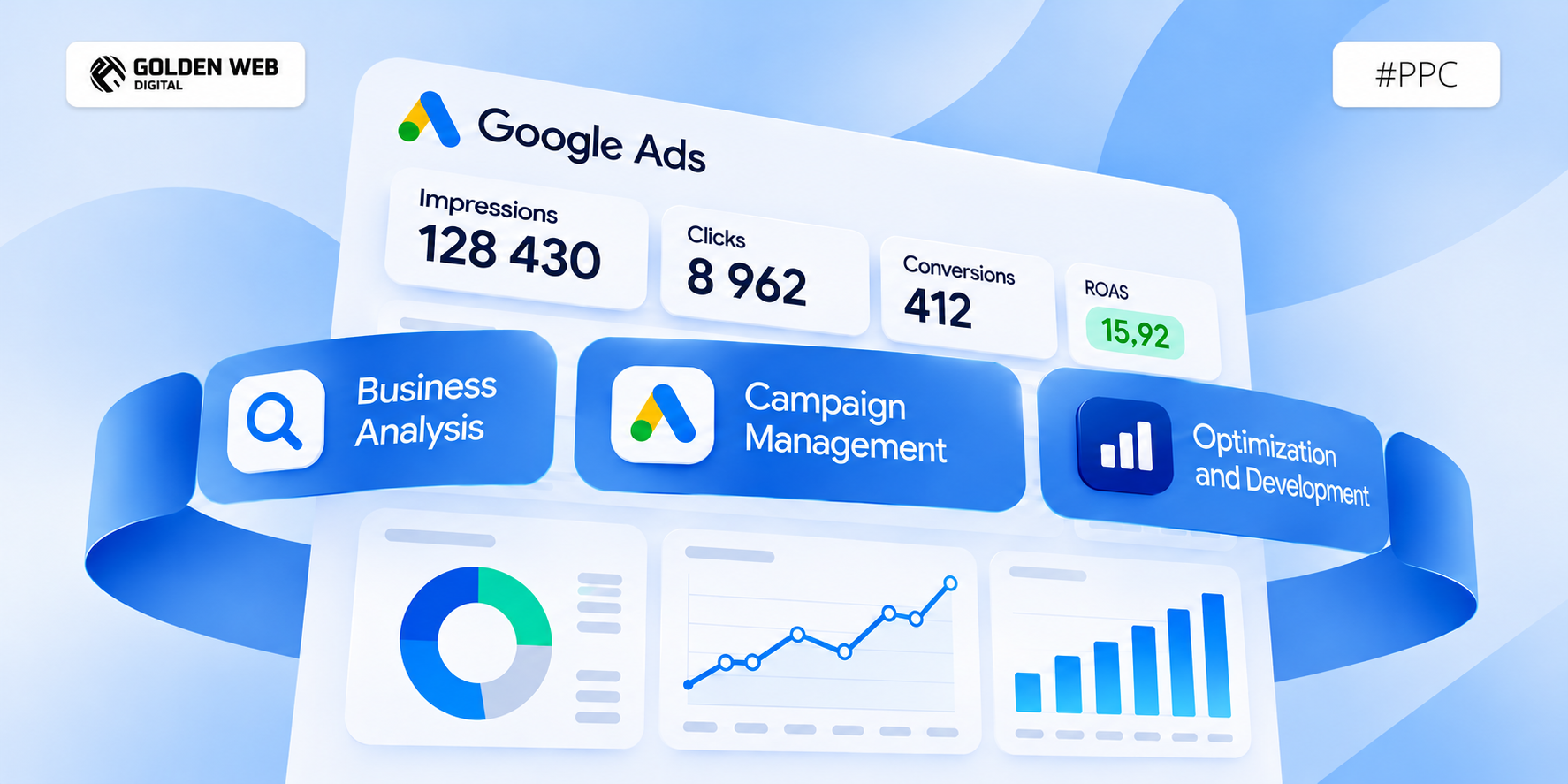
Launching a campaign is the beginning of the work, not the end.
Once campaigns are running, we gain real insights into:
Not every decision should be made immediately after the first impressions. Campaigns need enough data for adjustments to be based on meaningful patterns rather than random short-term fluctuations.
This is when ongoingcampaign management and optimization begin.
Google Ads campaignsshould not remain unchanged after launch. We regularly review different campaign components based on actual performance.
We analyze the actual searches that cause users to see and click ads.
We exclude irrelevant traffic, expand the keyword list, and refine keyword targeting.
We evaluate how individual campaigns spend their budgets and what results they generate for the business.
When necessary, we reallocate funds to higher-priority or more promising areas.
We compare how users respond to different advertising messages.
We test wording, key selling points, and offers to identify which messages best match the audience’s search intent.
If accumulated data shows that the current structure makes management or analysis difficult, we may revise how campaigns, ad groups, and business areas are organized.
We compare the performance of different segments and adjust targeting settings where necessary.
As conversion data accumulates, we may revise the bidding approach to align with the campaign’s current objectives.
Optimization is not one major change. It is ongoing work with different parameters based on actual performance.
No single metric can fully explain how well advertising is working.
That is why we evaluate a range of metrics according to the business model and project goals.
| Metric | What It Helps Measure |
|---|---|
| Impressions | how many times users saw an ad |
| Clicks | how many visits the ads generated for the website |
| CTR | how users respond to the advertising message |
| CPC | the average cost of a click |
| Conversions | the number of inquiries, purchases, calls, or other desired actions |
| CPA / CPL | the cost per conversion or lead |
| ROAS | the ratio of revenue generated by ads to ad spend, provided revenue data is tracked accurately |
But numbers alone say little without context.
For example, a lower CPC does not necessarily indicate an improvement if cheaper clicks do not lead to conversions.
That is why we assesshow metrics relate to one another and how they affect actual business results.
A report is not just a table of numbers presented to the client once a month.
Its purpose is to answer practical questions:
That is why our reports go beyond recording KPIs: we also analyze trends, including:
This way, clients see more than Google Ads statistics — they understandthe reasoning behind how their advertising budget is managed.
Even if campaigns have been running for a long time, their current settings may no longer be optimal.
A review is particularly relevant when:
In such cases, it makes sense to analyze the advertising account first and identifywhere opportunities are being lostbefore making any changes.
Request a Google Ads AuditThe question“how much does PPC advertising cost?”has no single answer because two different types of expenses need to be considered.
This is the money spent directly on ad impressions and clicks in Google Ads.
The client funds their own advertising account and controls these expenses.
This is the fee paid to the PPC team for campaign setup, management, analysis, and optimization.
We do not calculate our team’s fee as a percentage of the advertising budget. Ad spend and specialist services are billed separately.
Our service fee depends on:
Therefore,the cost of PPC advertising servicesis determined once we understand the scope of work and the specific project objectives.
Get a QuoteWe can join a new project that has never used Google Ads or take over an existing advertising account.
In the first case, we begin with an analysis and build the advertising system from scratch.
In the second, we review existing campaigns and performance data to avoid unnecessarily rebuilding what already works.
Tell us about your business, current advertising, and goals — our PPC specialist will help you identify the next step.
PPC Advertising FAQ
PPC advertising is a form of paid online advertisingthat displays ads to users based on search queries, interests, and other signals.
As part of this service, we manage advertising through Google Ads.
PPC advertising can generate paid traffic after campaigns launch, while SEO focuses on improving a website’s organic visibility in search results.
They are different search marketing tools that can be used separately or together.
Yes.Google AdWords is the former name of Google Ads.
Therefore, searches for “Google AdWords PPC advertising,” “AdWords PPC advertising,” or “PPC advertising in Google AdWords” now refer to the Google Ads platform.
The total cost consists ofthe advertising budget and the PPC team’s service fees.
The advertising budget depends on the industry, competition, location, and other factors, while the service fees depend on the scope and complexity of the work.
Yes.
In this case, we first analyze the advertising account and its current performance. Then we decide which settings to keep, what needs to be optimized, and how to organize the ongoing work.
The timeline depends on the project’s complexity, the number of business areas, website readiness, analytics setup, and other starting conditions.
Before launch, we need to conduct an analysis and prepare the campaign structure, keywords, ads, settings, and analytics.
No.
After launch, real performance data accumulates on user behavior, search queries, conversions, and costs. This data forms the basis for further optimization and more effective use of the advertising budget.